


Standing together and sending a message of reconciliation
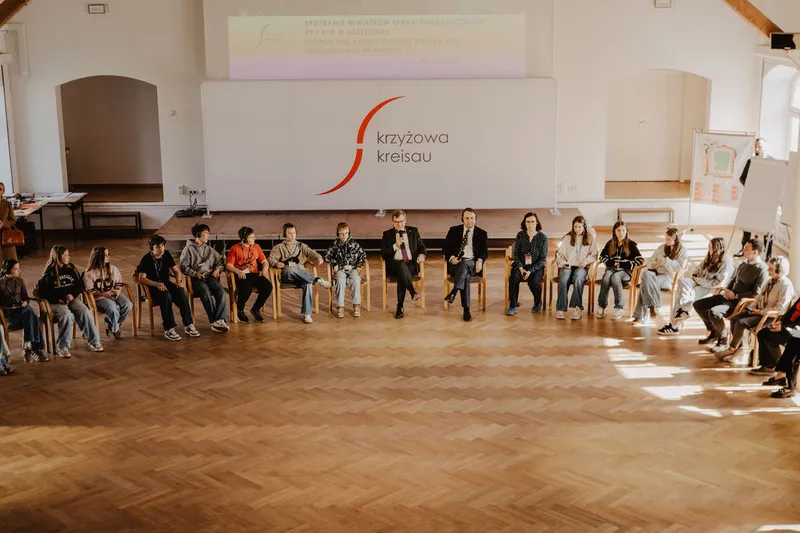
31. März 2026During the visit of the German and Polish Foreign Ministers Johann Wadephul and Radosław Sikorski to Krzyżowa on 30 March, it became clear how important German-Polish friendship remains today.

Thirty-five years after the signing of the German-Polish Friendship Treaty, they gathered at a place that, more than almost any other, stands for remembrance, courage, and understanding. Krzyżowa serves as a reminder not only of the Kreisau Circle’s resistance to National Socialism, but also of the reconciliation between Germany and Poland. In particular, the German-Polish Reconciliation Mass held on 12 November 1989, with Tadeusz Mazowiecki and Helmut Kohl, remains a powerful symbol of the renewed rapprochement between the two countries.
It is particularly significant that this visit also paid tribute to the founding of the Kreisau-Initiative in 1989 and the Krzyżowa Foundation in 1990, from which the International Youth Meeting Center emerged. A place that continues to build bridges to this day: between young people, between countries, and for a united Europe. While there, Wadephul and Sikorski were able to speak with young people in person.
In his statement, Wadephul emphasised the importance of civil society’s commitment to democracy: "Krzyżowa stands for the crucial importance of citizens’ personal engagement and courageous individual decisions. The aim of the Kreisau-Initiative [...] has always been to overcome borders and to facilitate contact between Germans, Poles and other Europeans [...]."
In politically and socially tense times in Europe, especially during Russia’s ongoing war of aggression against Ukraine, it becomes clear how valuable friendship, European cohesion, and solidarity in action are.
Krzyżowa reminds us that democracy, peace, and reconciliation cannot be taken for granted. They must be continually reshaped, together. And that is precisely why educational projects for young people are so important. Through these projects, they learn to actively help shape the democracy of tomorrow.
Johann Wadephul's full statement.
Photos: © Daria Moneta | Kreisau Foundation for European Understanding